Torii Gate 3D Shadow Box: A Layered Journey
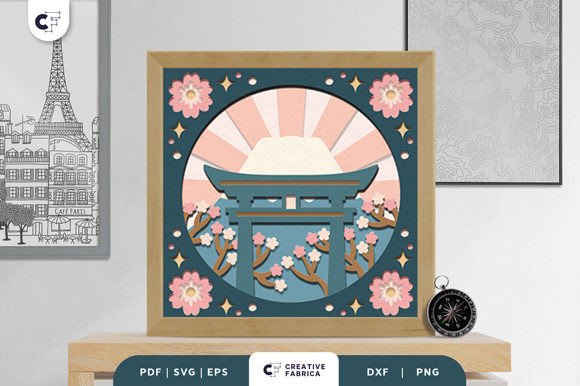
There is a specific kind of quiet majesty found in the traditional architecture of Japan, particularly in the iconic Torii Gate. These structures serve as spiritual markers, transitioning the mundane world into the sacred. Capturing that sense of peace and grandeur in a home decor project requires more than just a flat image; it demands depth, shadow, and light. The Torii Gate 3D Shadow Box Papercut offers exactly that—a tangible way to bring the serene atmosphere of a Japanese sunset village into your living space through the art of layered paper crafting.
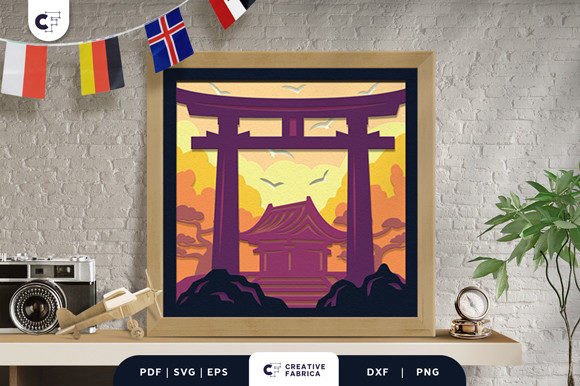
This isn't merely a craft kit; it is an exercise in spatial design. When you look at the finished piece, you aren't just seeing a picture of a gate. You are seeing a scene constructed across nine distinct layers. The foreground might feature delicate grasses or stone lanterns, leading the eye toward the central subject: a traditional Minka house nestled beneath the towering red beams of the Torii. Behind this, the background dissolves into the warm, gradient hues of a setting sun. The interplay between these layers creates a parallax effect that changes as you move around the room, mimicking the way light shifts in a real landscape.
The Architecture of Light and Paper
What makes the Torii Gate 3D Shadow Box Papercut so compelling for designers and hobbyists alike is its reliance on negative space and structural integrity. Unlike a standard print where the image is static, this project relies on the physical distance between sheets of cardstock to create volume. The recommended use of Encore Cardstock 80 lb cover 216 gsm is not arbitrary. This weight provides the necessary rigidity to hold the intricate cuts without warping, while still being thin enough to allow light to pass through if you choose to incorporate illumination.
The visual personality of this piece is defined by its silhouette work. In graphic design terms, we often talk about the importance of shape recognition. Here, the bold, geometric lines of the Torii contrast beautifully with the organic, softer curves of the surrounding nature and the architectural details of the Minka house. This contrast creates a natural visual hierarchy. Your eye is immediately drawn to the strongest vertical and horizontal lines—the gate itself—before exploring the finer details of the roof tiles and the horizon.
For those interested in editorial design or packaging design, studying how these layers interact offers valuable lessons in depth perception. The way the shadow falls from one layer to the next adds a level of realism that digital filters often struggle to replicate authentically. It is a reminder that sometimes the most effective design assets are the simplest ones: paper, adhesive, and light.
From Digital File to Physical Reality
Bringing this vision to life starts with the right digital foundation. The Torii Gate 3D Shadow Box Papercut is typically available in a suite of vector and raster formats, including SVG, PDF, EPS, PNG, and DXF. For the modern crafter using a cutting machine like a Cricut or Silhouette, the SVG format is often the gold standard. It preserves the precise paths needed for clean cuts, ensuring that even the most delicate bridges or tree branches remain intact.
However, the file is only half the battle. The assembly process is where the project transforms from a collection of shapes into a cohesive work of art. You will need 3D adhesive, such as foam double-sided tape, to separate the layers. The thickness of this adhesive dictates the depth of your shadow box. A standard 1mm foam tape might suffice for a subtle effect, but if you want dramatic shadows that emphasize the sunset backdrop, you might opt for thicker spacers or stack multiple layers of tape.
Lighting plays a pivotal role in the final presentation. While the piece stands beautifully on its own under ambient room light, integrating LED lights can elevate it to a stunning focal point. Placing a warm-white LED strip along the inner edge of the frame backlights the semi-translucent paper, making the sunset colors glow and casting long, soft shadows from the foreground elements. This technique borrows heavily from modern typography and signage principles, where illumination is used to enhance legibility and mood simultaneously.
Applications Beyond Home Decor
While the primary appeal of the Torii Gate 3D Shadow Box Papercut is as a wall hanging, its utility extends far beyond personal home decoration. For small business owners and creative entrepreneurs, understanding the mechanics of this project can open doors to various commercial applications. Consider the rise of experiential marketing and pop-up retail spaces. Brands are constantly seeking unique ways to engage customers, and large-scale paper installations offer a cost-effective yet high-impact solution.
Imagine a travel agency specializing in Asian tourism using a scaled-up version of this design in their lobby. It instantly communicates a sense of place and culture without needing a single word of copy. Similarly, in web design and social media graphics, the aesthetic of layered paper cutouts has become a popular trend. By creating a physical version first and photographing it with professional lighting, content creators can generate authentic textures and depth that stand out in a feed saturated with flat digital illustrations.
For publishers and book cover designers, the principles used here—layering, silhouette, and contrast—are directly applicable to creating striking display font pairings and cover art. The discipline required to ensure that nine layers of paper align perfectly translates to the precision needed in logo design and brand identity systems. It teaches patience and an eye for detail, qualities that are essential when selecting a premium font or curating a commercial font library for a client.
Practical Considerations for Execution
Before diving into your project, there are a few practical matters to address to ensure a professional result. First, always test your cuts on a scrap piece of your chosen cardstock. Even if you are using the recommended 80 lb cover, different machines have different pressure settings. A clean cut is crucial; any tear or jagged edge will be amplified once the layers are stacked.
Second, consider your framing options early. The standard size for many of these designs is 20.32×20.32 cm (approximately 8x8 inches), which fits nicely into standard square frames. However, if you plan to add LED lighting, you will need a frame with enough depth to accommodate both the paper layers and the wiring. A deep-box frame is ideal for this purpose.
Finally, keep in mind that color perception is subjective and dependent on your environment. The preview images you see online are digital representations. The actual final product color may slightly vary due to lighting sources and the specific batch of paper color you purchase. This variability is part of the charm of handmade items, but it is something to be aware of if you are trying to match a specific interior design palette.
Whether you are a seasoned paper artist or a beginner looking to explore the world of 3D crafting, the Torii Gate 3D Shadow Box Papercut offers a rewarding experience. It bridges the gap between digital convenience and tactile satisfaction, resulting in a piece of art that feels alive. By understanding the interplay of light, shadow, and structure, you can create a window into a tranquil Japanese village that resonates with anyone who sees it.